2026.07.31
 Industry News
Ink chemistry rarely gets attention on a retail packaging label, yet it accounts for a large share of the performance difference between a marker that fades within weeks and one that stays legible for years. Manufacturers producing double ended permanent pens for both consumer and industrial markets are investing more attention in ink formulation research than in barrel design, since the ink itself determines whether a pen earns repeat purchases from buyers who have already tested a competing brand.
Permanent ink relies on a solvent carrier to keep pigment in suspension until it dries on contact with a surface. Xylene-based solvents dry fast and bond aggressively to nonporous surfaces like plastic and metal, but growing workplace safety concerns around xylene exposure have pushed manufacturers toward alcohol-based alternatives for double ended permanent pens marketed to office and retail environments. Alcohol-based formulations dry slightly slower and may show reduced adhesion on certain plastics compared with xylene-based ink, a tradeoff manufacturers address through pigment concentration adjustments that compensate for the weaker solvent bond.
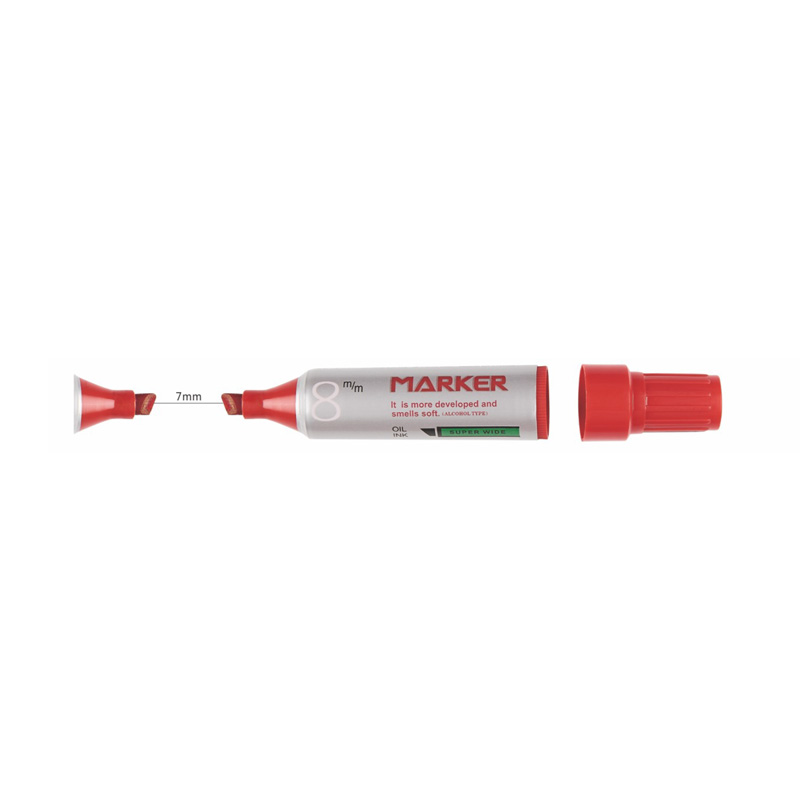
Industrial buyers working with metal and treated surfaces sometimes still prefer xylene-based double ended permanent pens specifically for the stronger adhesion properties, accepting the stronger odor and ventilation requirements in exchange for marking reliability on surfaces where alcohol-based ink underperforms. Suppliers serving both markets typically offer separate product lines rather than a single universal formulation, since no single solvent chemistry satisfies every surface and safety requirement across residential, office, and industrial buyers simultaneously.
Pigment particles need even dispersion throughout the ink reservoir to prevent color inconsistency across the pen's service life, since settled pigment produces a lighter mark toward the end of a pen's usable ink supply compared with marks made when the pen was freshly filled. Manufacturers testing double ended permanent pens for color consistency draw samples across the full ink volume rather than testing only from a freshly filled reservoir, checking whether pigment concentration stays stable as the pen approaches its rated capacity limit.
|
Ink Component |
Function |
Common Formulation Choice |
|
Solvent carrier |
Keeps pigment suspended, controls dry time |
Alcohol or xylene-based |
|
Pigment |
Provides color and opacity |
Dye-based or pigment-based |
|
Resin binder |
Bonds ink to the surface after drying |
Acrylic or polymer resin |
|
UV stabilizer |
Slows fade under light exposure |
Added for outdoor-rated ink |
Resin binders in the ink formulation create the actual bond between pigment and the marked surface once solvent evaporates, and binder chemistry affects both adhesion strength and smudge resistance immediately after marking. A quick-dry ink formula balances binder concentration against solvent evaporation rate, since a binder-heavy formulation dries slower but bonds more securely, while a solvent-heavy formulation dries fast but may smudge under light pressure before the resin fully sets.
Manufacturers producing double ended permanent pens for high-throughput labeling environments prioritize the faster-drying end of this balance, accepting a marginal reduction in ultimate bond strength in exchange for reduced smudging risk during busy shifts where labeled items move quickly between workstations before ink fully cures.
Pigment stability under UV exposure varies significantly between colorants, with black and dark blue pigments generally showing stronger fade resistance than red or green alternatives across extended outdoor exposure testing. Manufacturers building double ended permanent pens rated for outdoor or industrial use test each color in the product line separately rather than assuming uniform fade performance across the full color range, since a single UV-stabilizing additive package does not always compensate equally well for the different chemical structures underlying each pigment color.
Buyers selecting double ended permanent pens for a specific application benefit from understanding which ink chemistry underlies their chosen product line, since a pen optimized for glossy plastic labeling performs differently on porous cardboard than a formulation balanced for mixed-surface general use, and matching ink chemistry to the dominant surface type in a facility's workflow reduces the mismatch issues that surface only after bulk purchasing decisions are already locked in.
Suppliers increasingly publish ink datasheets alongside standard product specifications, listing solvent type, pigment class, and rated fade performance for each color in a product line rather than a single blanket durability claim covering the entire range. This documentation trend gives procurement teams a more reliable basis for comparing dual-tip marker lines across competing suppliers, particularly for buyers managing labeling programs spanning multiple environments — indoor storage, outdoor equipment, and electronics assembly — where a single ink chemistry rarely performs equally well across every surface and exposure condition the buyer's facility encounters.


Stationery Manufacturer
Information
 +86-577-86553287
 [email protected]
 Room 201, Building 2, District 3, Wanyang Innovation City, Bihu Town, Liandu District, Lishui City, Zhejiang Province
Contact Us



 English
  中文简体
中文简体  Español