2026.07.17
 Industry News
Watercolor Markers Washable products are often selected in a very different way compared with other school or art supplies. In many real purchasing situations, parents do not start by comparing colors or brightness. Instead, attention is quickly drawn to how easily the ink can be removed from skin, clothes, and household surfaces after use.
This behavior has gradually shaped how washable ink behavior is discussed in everyday consumer decisions, especially in households with young children.
In many buying situations, parents do not spend much time on color variety at the beginning.
Instead, they test or ask about cleaning performance first.
Whether ink can be removed from tables.
Whether it leaves marks on fabric.
Whether hands can be cleaned quickly after drawing.
These practical concerns often appear before any discussion about Watercolor Markers Washable color selection or artistic effect.
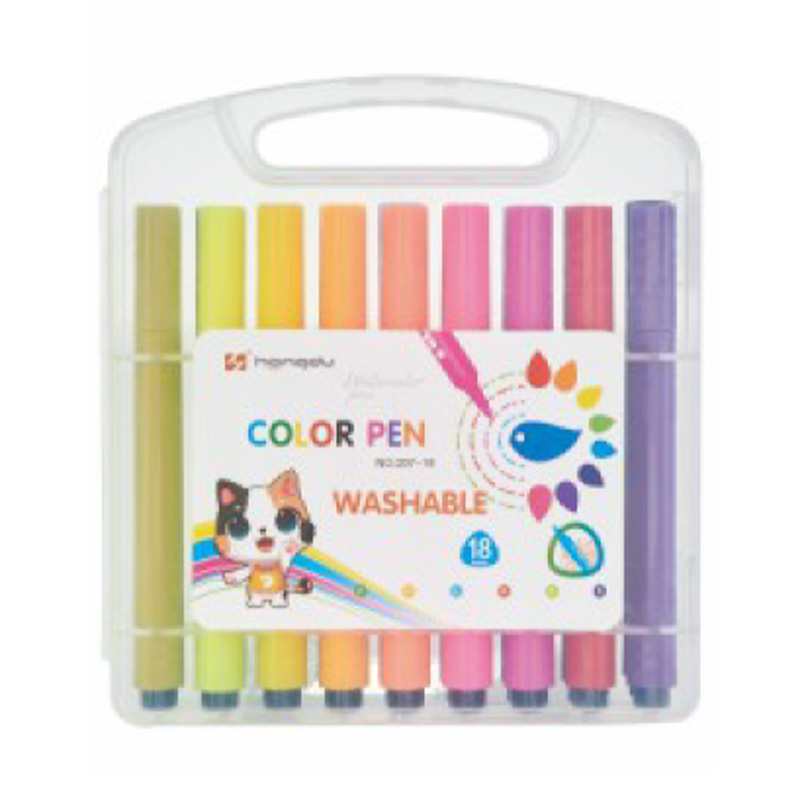
On store shelves or product pages, color range is often the most visible feature.
Bright packaging.
Multiple color options.
Art-style presentation.
However, in real households, usage is less about display and more about control.
Parents are usually thinking about mess level, not visual outcome.
This is where washable ink behavior becomes more important than appearance.
After children use markers once or twice, parents quickly form expectations.
Some inks wipe off easily from tables.
Some require repeated cleaning.
Some leave faint traces on fabric.
These small experiences strongly influence whether Watercolor Markers Washable products are considered suitable for continued use at home.
Parents often notice differences depending on where ink lands.
On smooth surfaces, cleaning feels simple.
On fabric or textured materials, removal becomes more difficult.
These repeated cleaning experiences gradually shape long-term preference for certain washable ink behavior characteristics, even without technical understanding of the product.
In many cases, “easy to clean” is indirectly associated with “safer for children”.
Parents tend to feel more comfortable when ink does not stay permanently on surfaces.
This perception influences repeated purchase decisions of Watercolor Markers Washable products in school supply and home-use environments.
Instead of comparing technical specifications, most parents rely on memory of past experience.
If cleaning was easy before, they are more likely to repurchase the same type.
If cleaning caused frustration, they may avoid similar products in the future.
This experience-driven pattern is a key factor behind how washable ink behavior affects consumer choice.
Although color variety is still visible in packaging, it often becomes a secondary factor after cleaning performance is considered.
Bright colors attract attention first, but usability determines final decision.
This shift explains why Watercolor Markers Washable products are often evaluated differently in real household use compared with retail presentation.
In practice, product value is not measured only by artistic output.
It is measured by how smoothly it fits into daily routines.
Less cleaning effort.
Less worry about stains.
More predictable results after use.
These everyday factors quietly influence how washable ink behavior is understood in real consumer environments.


Stationery Manufacturer
Information
 +86-577-86553287
 [email protected]
 Room 201, Building 2, District 3, Wanyang Innovation City, Bihu Town, Liandu District, Lishui City, Zhejiang Province
Contact Us



 English
  中文简体
中文简体  Español