2026.07.10
 Industry News
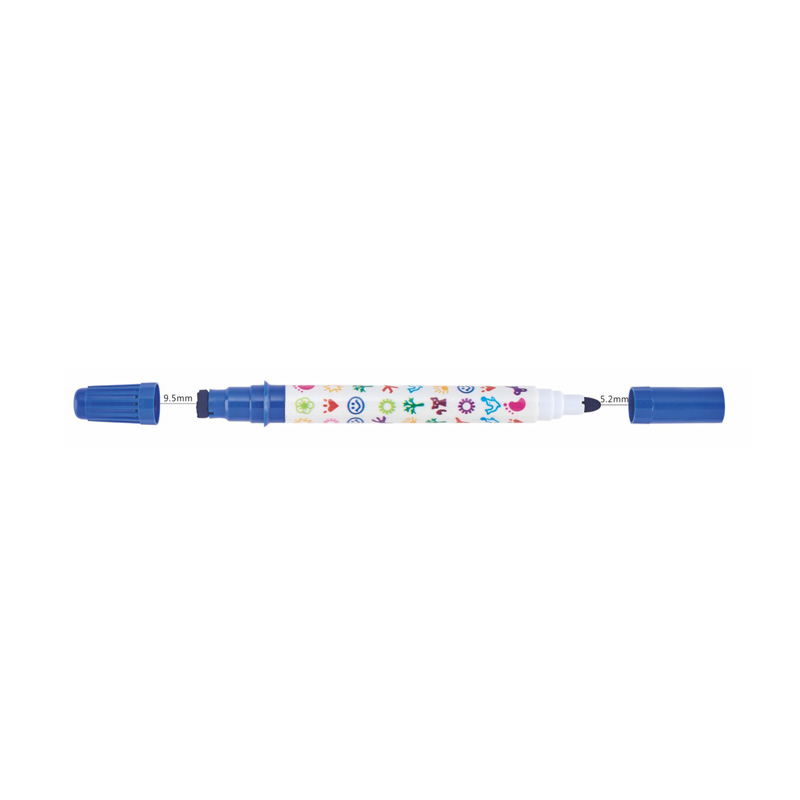
Warehouse operations and cable installation crews labeling equipment across large facilities face a practical constraint that office supply markers rarely address well: legibility that survives months of handling, temperature swings, and occasional chemical exposure. Procurement teams sourcing marking tools for these environments increasingly specify double ended permanent pens with tip options matched to both broad surface marking and fine detail work on the same barrel.
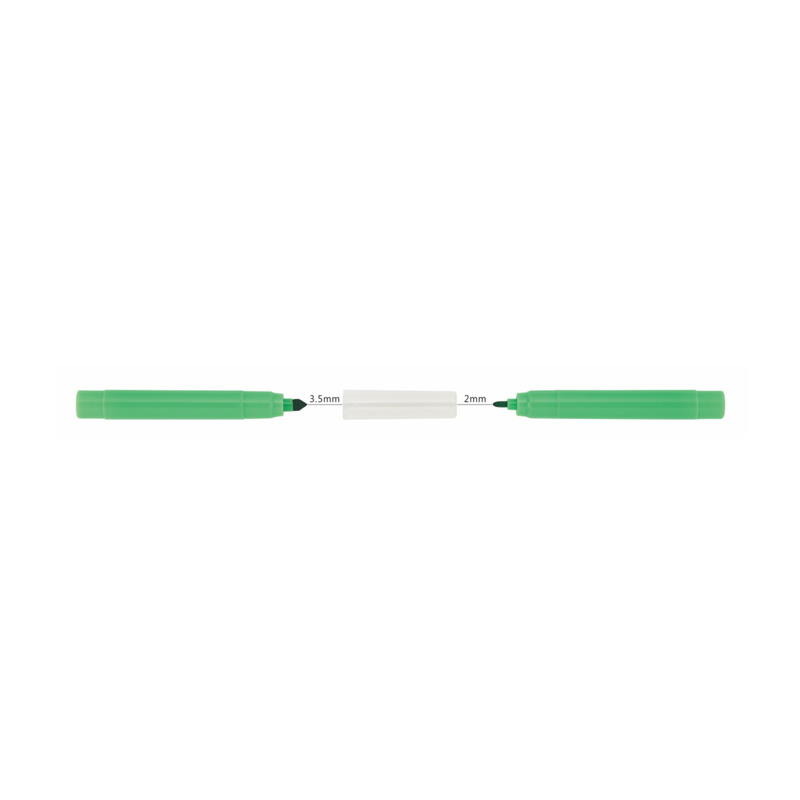
A dual-tip marker design pairs a broad chisel tip on one end with a fine bullet tip on the other, letting warehouse staff switch between large bin labeling and small component marking without carrying two separate pens. This pairing matters especially in facilities where labeling tasks vary widely across a single shift — a broad tip for shipping cartons in the morning, a fine tip for circuit board labeling in the afternoon. Manufacturers producing double ended permanent pens for industrial buyers test both tip ends against the same durability standards, since a fine tip that wears down faster than its broad counterpart creates an imbalanced tool that fails one application before the other.
Tip material selection affects the pen's performance against different surface textures. A felt tip wears faster against rough cardboard than against smooth plastic or metal, so factories supplying double ended permanent pens to mixed-use facilities recommend tip material rated for the roughest surface in the buyer's typical labeling workflow rather than optimizing only for the smoothest surfaces the pen might encounter.
Ink chemistry determines whether a label stays legible after prolonged exposure to sunlight, warehouse fluorescent lighting, or outdoor storage conditions. UV fade resistance testing exposes ink samples to accelerated light exposure equivalent to months of real-world sun exposure, measuring color retention against a baseline sample kept in dark storage. Ink formulations built specifically for industrial marking generally include UV-stabilizing additives absent from standard consumer-grade permanent ink, a difference that matters directly for labels applied to equipment stored outdoors or near warehouse skylights.
|
Application Environment |
Ink Priority |
Tip Recommendation |
|
Indoor warehouse storage |
Standard fade resistance |
Chisel and fine dual-tip |
|
Outdoor equipment marking |
High UV resistance |
Chisel tip, weather-rated ink |
|
Electronics and cable labeling |
Fine detail, quick-dry |
Fine bullet tip |
|
Construction site marking |
Smudge resistance, bold visibility |
Broad chisel tip |
Quick-dry ink formula development addresses a specific pain point in high-volume labeling environments, where wet ink smudged during handling immediately after marking creates rework and illegible labels. Ink viscosity plays a central role here, since thicker ink lays down more pigment per stroke but takes longer to set, while thinner ink dries faster but may show reduced opacity on darker surfaces. Manufacturers producing double ended permanent pens for high-throughput applications balance these two properties, targeting a formulation that dries within a few seconds of contact while still maintaining solid opacity on common packaging materials.
Surface adhesion testing checks the strength of ink bonding to plastic, metal, glass, and treated cardboard, since each surface interacts differently with permanent ink chemistry. Ink that adheres well to porous cardboard sometimes beads or smears on smooth plastic totes, a mismatch that surfaces only once a facility standardizes on a single marker across mixed storage container types. Suppliers running adhesion tests across a representative sample of common industrial surfaces give buyers clearer guidance on which ink formulation suits their specific mix of labeling substrates.
Industrial environments put more daily use cycles on a marking tool than typical office settings, and barrel construction on double ended permanent pens intended for this duty needs to withstand repeated dropping, rough handling, and storage in tool pouches alongside other equipment. Cap retention also matters more in industrial settings, since a loose-fitting cap left open even briefly on a job site leads to dried-out tips well before the ink supply inside the barrel runs low, cutting the tool's practical service life short regardless of the ink quantity remaining unused inside the barrel.
Facilities placing bulk orders for double ended permanent pens across multiple departments increasingly request batch-level quality documentation covering ink viscosity, tip firmness, and cap seal integrity, since inconsistent quality within a single shipment creates uneven labeling results across a facility even when every pen comes from the same production order. Suppliers maintaining tight tolerance control across production batches reduce the return rate tied to defective tips or dried-out ink that would otherwise surface only after a facility distributes pens across departments and staff begin reporting inconsistent performance.


Stationery Manufacturer
Information
 +86-577-86553287
 [email protected]
 Room 201, Building 2, District 3, Wanyang Innovation City, Bihu Town, Liandu District, Lishui City, Zhejiang Province
Contact Us



 English
  中文简体
中文简体  Español